
Guide · Music Informatics
Asturian bagpipe organology as data
How the Asturian bagpipe can be described in measurable terms — parts, key, and frequency range — and what you need to understand before digitising it.
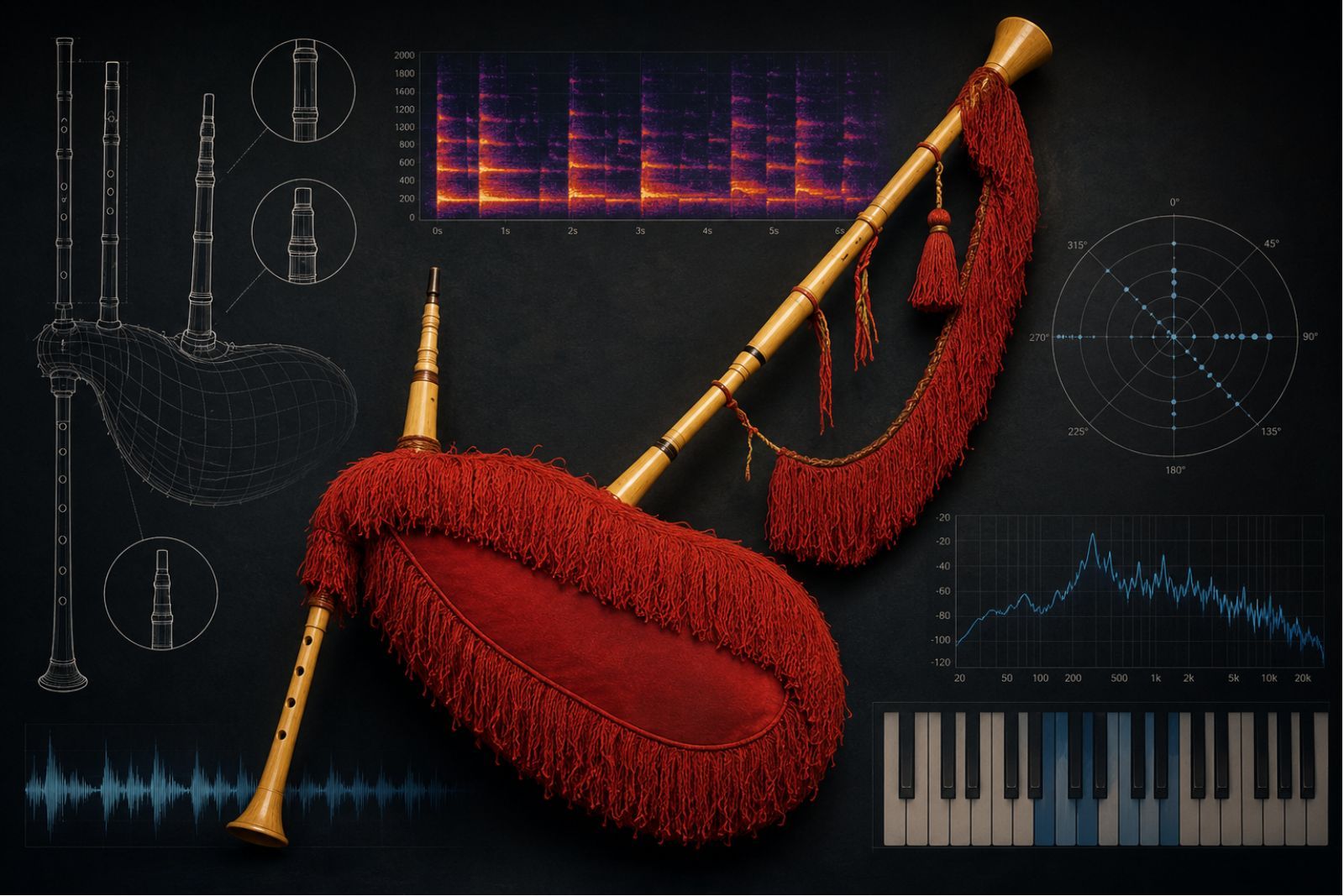
I have had the Asturian bagpipe between my hands for longer than I have been writing code, and today a good part of my work is about getting a computer to “listen” to an instrument and describe what it hears. When those two worlds meet, a very concrete, non-pedagogical question comes up: how do you describe the Asturian bagpipe in terms a system can process? Not how it is played — that belongs to teaching the instrument — but how it is measured, encoded, and represented as data. That is organology: the descriptive study of musical instruments, and the mandatory starting point before trying to digitise anything.
What organology is and why it matters here
Organology studies musical instruments from the point of view of their construction, classification, and acoustic behaviour, not from performance technique. It is the territory of parts, materials, measurements, keys, and frequency ranges. In a research notebook focused on music computing, that descriptive vocabulary is the first link in the chain: you cannot model, synthesise, or automatically transcribe an instrument you don’t have a precise description of.
The parts of the Asturian bagpipe
The Asturian bagpipe is a multiple-reed aerophone with an intermediate air reservoir. It is made up of four elements:
- Blowpipe (soplete): the tube through which the piper blows air into the bag. It includes a one-way valve that stops air flowing back out when the piper inhales.
- Bag (fol): the air reservoir, traditionally made of cured hide and today also of synthetic materials, which acts as a buffer and allows the continuous sound characteristic of bag-blown pipes.
- Chanter (punteru): the melodic tube, with a double reed (cane, similar to an oboe’s) at its tip and a series of finger holes that determine the pitch of each note.
- Drone (roncón): the bourdon tube, with a single reed, that produces a single continuous low tone while the melody sounds. Depending on the model, it may also carry the ronquín, a secondary, higher-pitched drone.
From an organological point of view, this structure — air reservoir + double-reed melodic pipe + single-reed drone — is what places the Asturian bagpipe within the European family of bag-blown pipes, alongside the Galician gaita, the Scottish Great Highland Bagpipe, or the Irish uilleann pipe, each with its own combination of tubes, reeds, and fingering.
Key and scale
Traditional Asturian bagpipes are built factory-tuned to a fixed key — the instrument does not modulate or change key the way a piano does. The most common are B flat, C, and D, and that choice conditions both the timbre and the repertoire each instrument is usually paired with.
Through its finger holes, the chanter reproduces a nine-note diatonic scale within a range of roughly a ninth — from the first degree of the key up to the ninth — plus a few altered notes obtained with specific fingerings of the instrument (cross-fingerings). This sets it apart from a fully chromatic instrument: the available range is bounded by the physical design of the tube and the number of holes, it is not configurable.
Frequency range: when key becomes hertz
Translating the factory key into concrete frequencies is the first real step
towards any digital treatment of the instrument. Taking equal temperament
with A4 = 440 Hz as a reference, a bagpipe in B flat places the chanter’s
fundamental note at around 233 Hz (B♭3), with the instrument’s full range —
chanter plus drone — extending roughly between the 115 Hz of the low drone
and the 500 Hz of the chanter’s highest notes. [These figures are indicative: the actual tuning of each instrument varies with the maker, temperature, the humidity of the bag, and reed wear, and does not necessarily follow Western equal temperament strictly.]
That variability is not a manufacturing defect: it is a feature of reed-and-bag instruments, which respond to air pressure in a much less stable way than an instrument with a rigid mouthpiece or an electronic keyboard. For any audio analysis system working with bagpipe recordings, that fluctuation — not just the “ideal” note on the score — is part of the real signal that has to be modelled.
The bridge to digitisation
This is where organology stops being a descriptive fact sheet and becomes a technical requirement. Before designing any system that listens to a bagpipe and recognises what it plays, you need to know beforehand: how many notes the scale has, what frequency range the chanter moves in, how the drone’s continuous bourdon behaves — a stable source of spectral energy that a pitch-detection system has to learn to separate from the melody — and how much tuning variation is “normal” for the instrument versus what would be a mistake by the piper or the system.
That last point connects directly with one of the central problems of automatic music transcription: polyphony and timbre complicate the task, and an instrument with a continuous drone like the bagpipe — with a low note sounding without interruption under the melody — is, in practice, polyphonic by design. An AMT system trained on piano does not generalise well to the bagpipe without adapting to this particularity.
That said, the drone is not always present in the signal to be analysed: in group settings, when several pipers play together with other instruments, professionals commonly remove the drone from the instrument precisely so as not to complicate the ensemble’s harmonies. A transcription system designed for bagpipe has to account for both cases — with drone and without — as legitimate variants of the same source, not as an anomaly to correct.
Once a bagpipe’s audio signal has been transcribed into discrete notes, the natural format for representing those instructions is MIDI: which note sounds, when it starts, when it ends, and at what intensity. MIDI does not describe the chanter’s characteristic timbre or the texture of the drone — the original audio signal handles that — but it does offer the symbolic layer on which a repertoire of bagpipe music can be indexed, searched, and compared systematically, the same way it already happens with piano corpora or other instruments better covered by MIR research.
Organology and pedagogy: two different territories
It’s worth stating this clearly: describing the instrument — its parts, its key, its frequency range — is not the same as teaching someone to play it. Fingering, breath and bag control, or ornamentation technique belong to instrument teaching, not to this notebook. I cover that side — the pedagogical one — from a different place: EMTI Fervienza, the traditional-music school I direct, focused on teaching the Asturian bagpipe. Here, instead, I’m interested exclusively in the instrument as an object of acoustic study and as a source of data.
References
The references this article draws on, and where to read further:
- Benetos, E., Dixon, S., Duan, Z., & Ewert, S. (2019). Automatic Music Transcription: An Overview. IEEE Signal Processing Magazine, 36(1), 20–30.
- Fletcher, N. H., & Rossing, T. D. (1998). The Physics of Musical Instruments (2nd ed.). Springer.
- Von Hornbostel, E. M., & Sachs, C. (1914). Systematik der Musikinstrumente: Ein Versuch. Zeitschrift für Ethnologie, 46, 553–590.
- The MIDI Association. The Official MIDI Specifications.
Frequently asked questions
-
How is organology different from learning to play the bagpipe?
Organology studies the instrument from its construction, classification, and acoustic behaviour: how many parts it has, what key it is tuned to, what frequency range it covers. It does not cover how a note is fingered, how the bag is controlled with the arm, or how an ornament is articulated with the chanter’s double reed — that is performance technique, the territory of teaching the instrument. On labs.tever.es the Asturian bagpipe is treated as an object of acoustic study and a source of data; the pedagogical side lives in a different space, outside this notebook. More detail in Asturian bagpipe organology.
-
How many notes does the Asturian bagpipe chanter have?
The chanter of the Asturian bagpipe is the melodic tube: a series of finger holes on a body with a double reed determines the pitch of each note. It reproduces a nine-note diatonic scale within a range of roughly a ninth — from the first degree of the factory key up to the ninth — plus a few altered notes obtained with specific fingerings of the instrument, known as cross-fingerings. Unlike a keyboard, the available range is not configurable: it is fixed by the physical design of the tube and the number of holes. More context on how that scale translates into concrete frequencies in Asturian bagpipe organology.
-
Why does the drone complicate automatic transcription of the bagpipe?
The drone is the bourdon tube of the Asturian bagpipe: it produces a single continuous low tone while the chanter’s melody sounds. For an audio analysis system, that means the bagpipe is, by design, an instrument with two simultaneous sound sources — one fixed and stable, the other variable and melodic. Separating that mixture is a problem equivalent to the one posed by polyphony in instruments such as the piano: the frequencies of the drone and the chanter overlap in the spectrum, and the system has to learn to tell apart the constant bourdon from the note that changes. That said, the drone does not always sound: in group settings, when several pipers play alongside other instruments, professionals commonly remove it so as not to complicate the ensemble’s harmonies, so a transcription system has to account for both variants — with drone and without — as equally valid. I develop this in Asturian bagpipe organology, and the general problem of polyphony in what automatic music transcription is.