
Essay · Music Informatics
Rhythm games: music as the conductor of training
Stage Tour announces RedOctane's return. The announcement is the hook; the underlying idea —music as the conductor of a training system— predates five buttons.
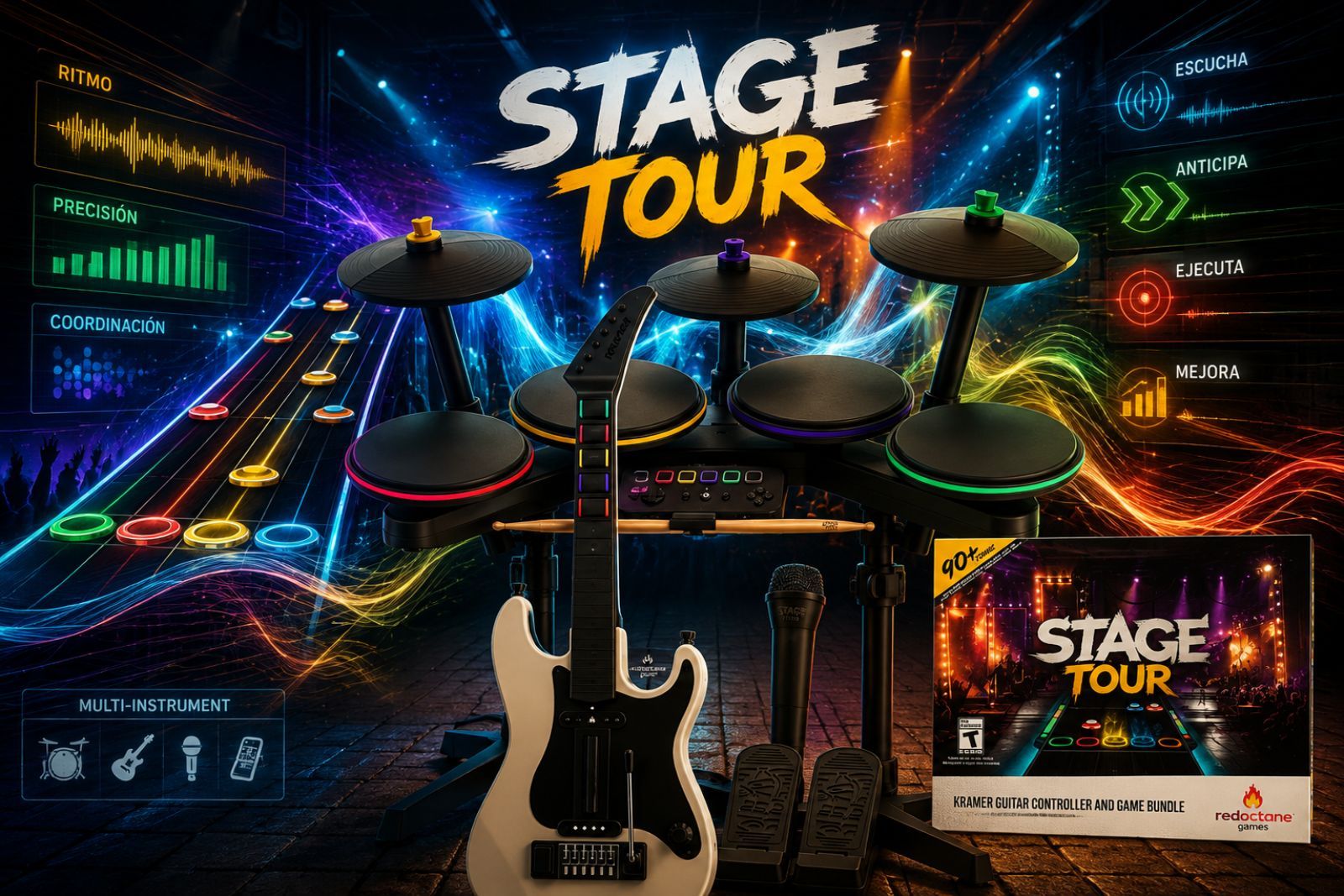
RedOctane Games —a new studio formed by members of the original RedOctane behind Guitar Hero, together with former Neversoft and Harmonix developers, backed by Third Kind Games and Eidos Montréal— has announced Stage Tour, a new rhythm game with a release date of December 10, 2026 on PC, PS5, Xbox Series X|S and Switch 2. The numbers are what you’d expect from a launch of this scale: over 90 officially licensed songs, more than 180 licensed Gibson, Epiphone and Kramer guitars, and supported instruments ranging from lead and groove-bass guitar to a kick-pedal drum kit, microphone, and a conventional gamepad or keyboard.
I’m not going to cover Stage Tour as news. The game hasn’t shipped, there’s no public code to audit, and this notebook doesn’t run advance coverage of other people’s announcements. What does interest me —and what this article is actually about— is the question the announcement reopens: what, exactly, is a game like this? Because stripped of the marketing, a rhythm game is a skill-training system, and that principle is far older and far more general than any single title.
What a rhythm game really is
A game like Guitar Hero —or its announced successor, Stage Tour— reduces a physical interface to a binary signal: hit or miss, on time or off time. Five coloured buttons and a strum bar are, from the system’s point of view, discrete sensors that must be triggered at the exact instant marked by the game’s score. There’s no room for timbral interpretation or expressive nuance: there’s a correct time window, and a response that falls inside it or outside it.
What’s interesting isn’t the interface, it’s the mechanism underneath it:
- There’s a musical track that acts as the conductor —in the literal sense of the one setting the tempo, not a cable—: it defines in advance when each event should occur. That timestamped event stream is, in essence, the same thing a MIDI file encodes: which note, when it starts, at what intensity —except here the event doesn’t trigger a sound, it triggers the comparison against a gesture.
- The system presents that reference far enough ahead of time for the player to anticipate the gesture —the notes falling down the screen before reaching the hit line.
- The system measures the time distance between the instant marked by the music and the actual instant of the physical response.
- That distance becomes a score, a combo or an energy bar: a metric of accuracy, not of taste.
That mechanism doesn’t depend on the interface having five buttons. It depends on just three pieces: an external temporal reference, a sensor that captures a physical response, and a function that compares the two. The plastic button is the cheapest and most commercially viable implementation of that principle —building a controller with five discrete inputs is trivial compared to instrumenting a real instrument—, not its definition.
On top of that core, Stage Tour also announces a layer of structured variation: according to the announcement’s coverage, its Tour mode works as “a campaign inspired by roguelites”, where each run presents different setlists, challenges, modifiers and routes, with powers and items to pick between shows. It’s a layer of controlled randomness sitting on top of the training mechanism —which song plays when and at what difficulty—, not a change to the mechanism itself: the smallest unit is still the same comparison between expected time and executed time, repeated note by note.
The same idea ten years earlier, with a real instrument
This isn’t a new idea for me. In 2011 I applied it to a real instrument —the gaita asturiana— in my final degree project, with the punteru turned into the source of the signal being evaluated instead of a button. A student would play a score in front of a microphone and the system checked the performance against a written reference: the same underlying principle —music as conductor, physical gesture as response, the distance between the two as the measurement—, applied to a wind instrument with a reed and a continuous drone instead of a plastic neck with five buttons. I cover that project in detail, including where the press nickname it got came from, in De Gaita Hero a EMTI Fervienza; I won’t repeat it here. Anyone who wants to understand why evaluating a gaita asturiana performance is a considerably harder problem than detecting whether a button was pressed —because of the polyphony introduced by the roncón, among other things— will find the full breakdown there, and also in the organology of the gaita asturiana, where I detail the soplete, fol, punteru and roncón as components of the instrument.
The difference between Stage Tour and that 2011 project isn’t in the principle, it’s in the contact surface. A button can only be pressed or not pressed: the signal is clean by construction. A real instrument —a gaita, an acoustic guitar, a voice— produces a continuous signal, full of nuances of pitch, timbre and dynamics that have to be extracted before it can be compared against anything. Evaluating accuracy in a rhythm game is trivial compared to evaluating the performance of a real instrument; it is, literally, the same problem with the difficulty reduced to its minimum.
An idea that doesn’t have to stay at five buttons
If the underlying principle —using music as the conductor of a skill-training system, and measuring the accuracy of the response against that reference— works just as well with a plastic button as with the punteru of a gaita asturiana, the question that really interests me isn’t how many licensed guitars a launch catalogue ships with. It’s how far that idea can be generalised without losing what makes it useful: any real instrument, not just the ones that fit onto a five-button neck, is in principle a candidate for the same kind of training system. This isn’t an idea I’m going to develop here and now —it remains, for me, more of an open question than a closed project—, but it’s the question this announcement leaves me with, beyond the announcement itself.
Frequently asked questions
Does a rhythm game like Stage Tour use a different principle from an instrumental performance evaluation system?
Not in anything essential. Both share the same underlying mechanism: a musical reference marks the correct time of a physical response, and the system measures the distance between what was expected and what was executed. The difference lies in the complexity of the input signal —a button is binary, a real instrument isn’t— and in the goal —commercial entertainment versus pedagogical evaluation—, not in the principle that underpins them.
Does Stage Tour have any technical relation to the 2011 Gaita Hero project?
No technical or development relation whatsoever. They’re independent projects with no link between them. The connection this article draws is purely conceptual: both are examples of the same design principle —music as the conductor of a skill-training system— applied to very different interfaces, separated by more than a decade.
References
- RedOctane Games. Stage Tour — official website, with song catalogue, controllers and launch packs.
- Hobbyconsolas. «Stage Tour, el sucesor espiritual de Guitar Hero, se lanza en diciembre».
- Vandal. «Stage Tour ya tiene fecha: el heredero de Guitar Hero tendrá más de 90 canciones y modo roguelite».
Frequently asked questions
-
Does a rhythm game like Stage Tour use a different principle from an instrumental performance evaluation system?
Not in anything essential. Both share the same underlying mechanism: a musical reference marks the correct time of a physical response, and the system measures the distance between what was expected and what was executed. The difference lies in the complexity of the input signal —a button is binary, a real instrument isn’t— and in the goal —commercial entertainment versus pedagogical evaluation—, not in the principle that underpins them. I develop this in Rhythm games: music as the conductor of training.
-
Does Stage Tour have any technical relation to the 2011 Gaita Hero project?
No technical or development relation whatsoever. They’re independent projects with no link between them. The connection this article draws is purely conceptual: both are examples of the same design principle —music as the conductor of a skill-training system— applied to very different interfaces, separated by more than a decade. I develop this in Rhythm games: music as the conductor of training.