
Guide · Music Informatics
What MusicXML is: the score as data
Moving a score between programs without it falling apart seems trivial, and it is not. What MusicXML is and how it differs from MIDI.
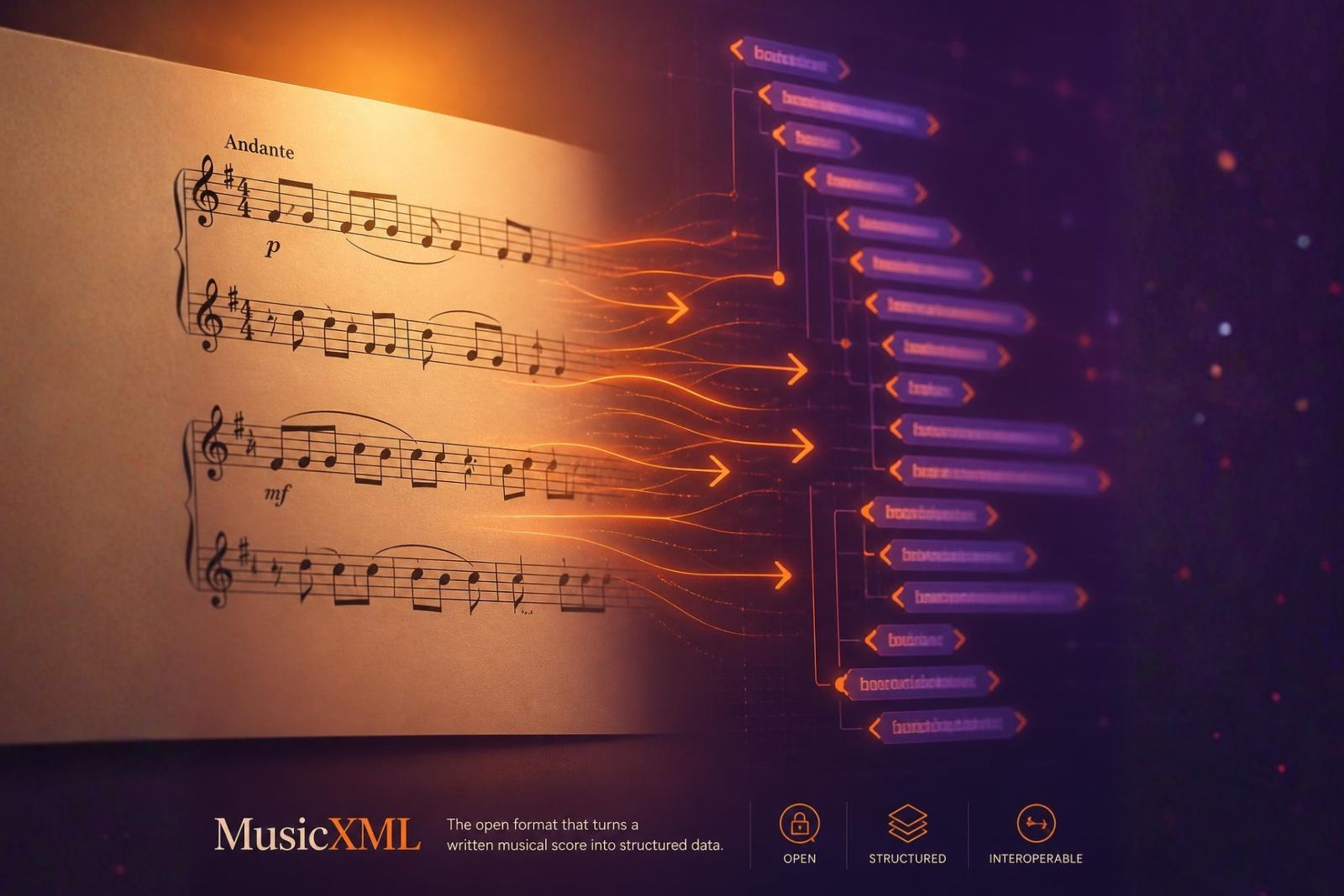
It has happened to me more times than I would like: I finish writing a score in one program, try to open it in another, and it arrives broken — slurs are lost, the song lyrics, sometimes even a note here and there. That very concrete problem, moving a score from one place to another without it falling apart, is exactly the one MusicXML came to solve.
What MusicXML is
MusicXML is an open format for exchanging digital scores. It is maintained by the W3C Music Notation Community Group, its current version is 4.0 (2021), and today more than 250 notation, editing, and music analysis programs support it. In short: it is the standard format that lets two different applications hand a score to each other and understand one another.
Notation, not sound
It is worth not confusing it with MIDI. MIDI describes a performance — which note sounds, when, and how hard; it is the plane of execution. MusicXML describes the written score: the clef, the key signature, the rests, the slurs, the articulations, the lyrics under the notes. One stores how something is played; the other, how it is written.
They are two complementary views of the same music. That is why many programs export to both: to MIDI so it sounds, to MusicXML so it can be printed, edited, or analysed.
What it looks like inside
The “XML” in the name is not decorative: a MusicXML file is plain text, readable by a person and by a machine. A single note — a middle C lasting a quarter — is described like this:
<note>
  <pitch>
    <step>C</step>
    <octave>4</octave>
  </pitch>
  <duration>4</duration>
  <type>quarter</type>
</note>
You do not need to understand every tag to grasp the idea: each musical element — pitch, octave, duration, figure — is written down as structured data. That is what makes the score stop being an image and become manipulable information.
MusicXML versus MIDI
| MIDI | MusicXML | |
|---|---|---|
| Represents | The performance (the sound to produce) | The notation (the written score) |
| Unit | Event messages (note on/off) | Score elements (notes, bars, clefs) |
| Used for | Playing back, sequencing | Editing, printing, analysing |
| Format | Binary | Readable XML text |
Neither replaces the other. If you want the music to sound, MIDI; if you want it read and preserved as a score, MusicXML.
Why it matters in research
For anyone who studies music with computational tools, MusicXML is a bridge. It lets a score travel between programs without losing information, be archived in an open format that does not depend on a single vendor, and be treated as data for analysis. It is also one of the natural outputs of automatic music transcription: when a system listens to a recording and infers the notes, MusicXML is one of the formats in which it can write the result so that a person can read it, correct it, and reuse it. That same readability is what makes it useful in Music Information Retrieval, where analysis often starts from the symbolic plane rather than from the audio. I go into the concrete difference between what MIDI keeps and what MusicXML keeps —with real code and real figures, not just in theory— in MIDI vs MusicXML in Python: what survives and what doesn’t.
Why it matters to me
I come back to the idea that runs through everything I do: joining instruments with systems that know how to make use of what happens when you play. A recording captures the sound; a score in MusicXML captures the structure, and it does so in a format that will still open many years from now. To document and study a repertoire — especially one that is poorly collected — having the music as open, readable data is not a luxury: it is the difference between preserving and losing.
References
The references this article draws on, and where to read further:
- W3C Music Notation Community Group. (2021). MusicXML 4.0.
- MusicXML — the format’s official site (documentation and tutorial).
- Good, M. (2001). MusicXML: An Internet-Friendly Format for Sheet Music. In Proceedings of XML 2001.
- Selfridge-Field, E. (Ed.). (1997). Beyond MIDI: The Handbook of Musical Codes. MIT Press.
Frequently asked questions
-
¿Para qué sirve MusicXML en la investigación musical?
Para quien estudia música con herramientas informáticas, MusicXML es un puente. Permite que una partitura viaje entre programas sin perder información, archivarla en un formato abierto que no dependa de un fabricante y tratarla como dato para analizarla. Es, además, una de las salidas naturales de la transcripción automática de música: cuando un sistema deduce las notas de una grabación, MusicXML es uno de los formatos en los que puede escribir el resultado para que una persona lo lea y lo corrija. Más en ¿Qué es MusicXML?.
-
¿En qué se diferencia MusicXML de MIDI?
Son dos miradas complementarias a la misma música. MIDI es el plano de la interpretación: mensajes de evento que dicen qué nota suena, cuándo y con qué intensidad; sirve para reproducir y secuenciar. MusicXML es el plano de la notación: claves, armaduras, silencios, ligaduras, articulaciones y letra; sirve para editar, imprimir y analizar la partitura. Por eso muchos programas exportan a ambos. Si quieres que la música suene, MIDI; si quieres que se lea y se conserve como partitura, MusicXML. Lo comparo en ¿Qué es MusicXML?.