
Essay · Music Informatics
What Music Information Retrieval (MIR) is
The field behind automatic transcription, chord recognition, and Shazam. What MIR is and how MIDI, MusicXML, and AMT fit into it.
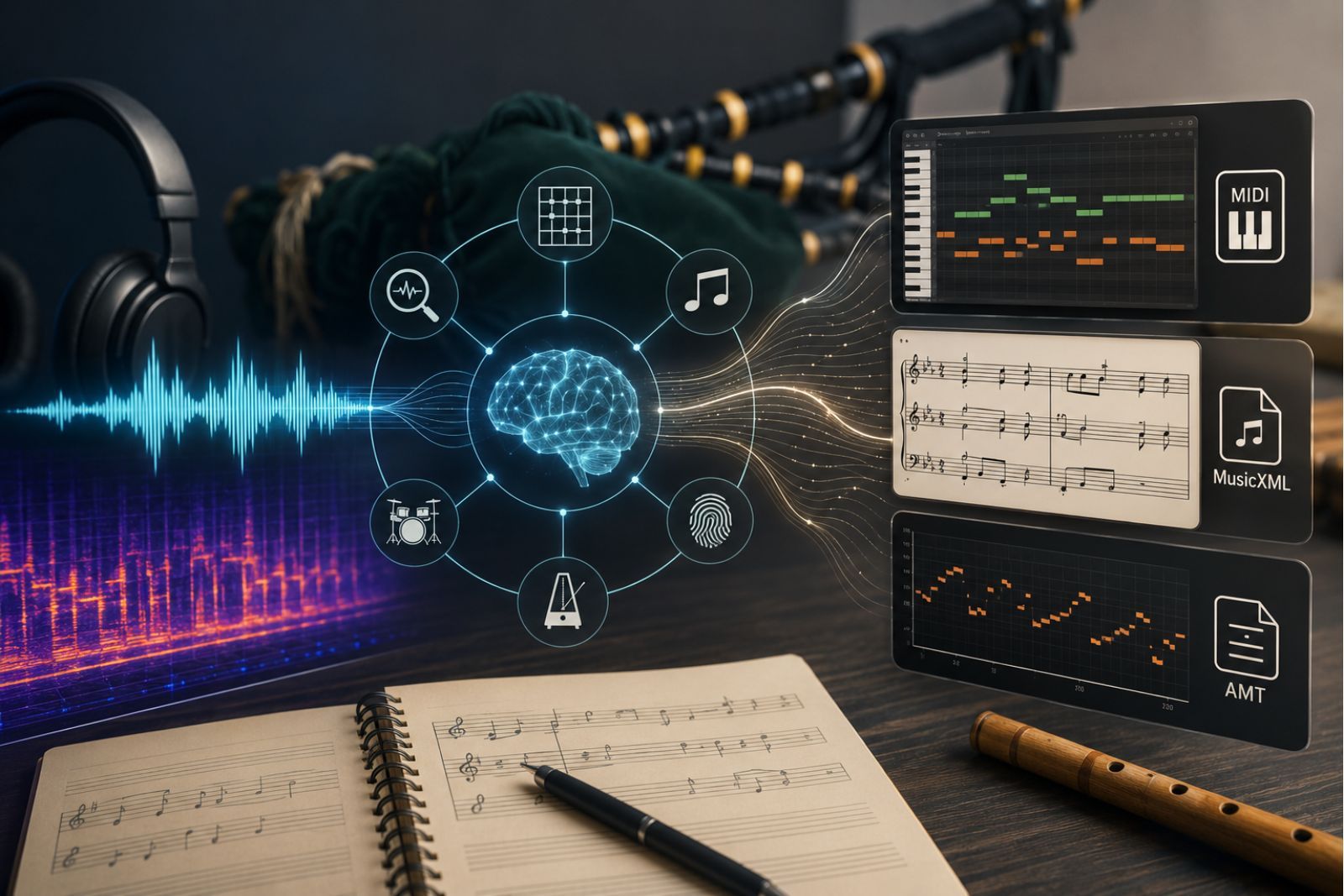
Every time Shazam recognises a song in three seconds, or a player separates the vocal from the instrumental, or my own work turns a recording into a score, the same thing is happening underneath: Music Information Retrieval (MIR). It is not a tool or a product: it is the research field that makes all of that possible.
What MIR is
Music Information Retrieval is the field of computer science that studies how to extract, organise, and retrieve information from musical signals — whether recorded audio or symbolic score. The underlying question is always the same: given a piece of music, what can be known about it automatically?
Under that question sit very different tasks:
| Task | What it answers |
|---|---|
| Chord recognition | What harmony sounds at each instant |
| Source separation | Isolating the voice from the guitar in a mix |
| Tempo identification | How fast the piece goes |
| Genre classification | What style it belongs to |
| Fingerprint retrieval | Which song this is (Shazam) |
| Automatic music transcription (AMT) | Which notes are being played |
A clarification worth making, because in Spain the acronym causes confusion: the MIR I mean here is not the medical MIR (Spain’s residency programme for junior doctors, Médico Interno Residente). It is a discipline of computer science, with its own research community — the International Society for Music Information Retrieval (ISMIR), founded in 2000 — and its own annual conference, which is the reference event of the field.
Where MIDI, MusicXML, and AMT fit within MIR
If you have already read the earlier articles on this blog about MIDI, MusicXML, or automatic transcription, you probably treated them as separate pieces. They are not: they are part of the same field, with different roles.
MIDI and MusicXML are output formats: when an MIR system solves the transcription task, the result — notes, timings, pitches — has to be represented somehow, readable by machine and by person. MIDI does it with playback or sequencing in mind; MusicXML, with an editable printed score in mind. Neither of the two does MIR by itself: they are the vocabulary in which one of its results gets expressed.
AMT (automatic music transcription) is, within MIR, the specific task that interests me most: converting audio into symbolic representation. It is just one of the tasks in the table above, though it is the one at the centre of my doctoral research.
And artificial intelligence — which I already wrote about in an earlier article — is, today, the dominant technique for solving most of these tasks: neural networks trained on large corpora of annotated audio. But MIR predates the rise of those techniques — ISMIR has been running since 2000 — and not all of its tasks depend on deep learning: tempo recognition, for instance, is solved well with classic signal-processing methods, with no trained model needed.
My research within MIR
My doctoral work focuses on polyphonic automatic music transcription: pieces where several notes — and often several voices — sound at once, the hard case within AMT. I work on piano, taking current state-of-the-art systems as a starting point — Basic Pitch, Onsets & Frames, MT3 among them — and my focus is understanding where and why those systems fail note by note, not just repeating their final accuracy figure. A model that gets 90% of notes right can be failing consistently on the same kind of passage — dense chords, very short notes, sustained pedal — and that distinction matters more than the overall number.
From there I explore representations of the audio signal that are alternatives to the ones those models use, looking at whether a different way of looking at the audio — before it enters the model — helps correct any of those systematic failures. It is ongoing research work: some of the hypotheses I test are confirmed, others are discarded, and both are valid outcomes in the way I document this work in the open.
References
The references this article draws on, and where to read further:
- Müller, M. (2015). Fundamentals of Music Processing: Audio, Analysis, Algorithms, Applications. Springer.
- International Society for Music Information Retrieval. ismir.net — the field’s annual conference and Transactions of the International Society for Music Information Retrieval (TISMIR), its open-access journal.
Frequently asked questions
-
¿Qué diferencia hay entre AMT y MIR?
MIR —Music Information Retrieval— es el campo que estudia cómo extraer información útil de la señal musical de forma automática: detectar el tempo, reconocer acordes, separar instrumentos, identificar una canción. AMT —Automatic Music Transcription— es una tarea concreta dentro de MIR: convertir una grabación de audio en su representación simbólica (notas, duraciones, instrumentos). La AMT es la tarea central de mi investigación doctoral.
-
¿Qué es el Music Information Retrieval (MIR)?
El Music Information Retrieval (MIR) es el campo de la informática que estudia cómo extraer, organizar y recuperar información a partir de señales musicales. Abarca tareas muy distintas: reconocimiento de acordes, separación de fuentes (aislar la voz de la guitarra en una mezcla), identificación del tempo, clasificación de género, recuperación de piezas similares por huella acústica y, como tarea central para mi trabajo, transcripción automática de música. Si alguna vez has visto que Shazam reconoce una canción en tres segundos, estás viendo MIR aplicado.
Una aclaración necesaria: MIR no es el MIR médico (Médico Interno Residente). En España la coincidencia de siglas genera confusión frecuente. El MIR del que hablo aquí no tiene relación con la especialización médica; es una disciplina de la informática y las ciencias de la computación, con su propia comunidad de investigación, sus conferencias (ISMIR) y sus corpus de referencia.
Mi investigación se encuadra en MIR aplicado a la transcripción automática de música (AMT): trabajo sobre piano polifónico, analizando dónde y por qué fallan los sistemas actuales del estado del arte. El repertorio de gaita asturiana —escaso en los benchmarks internacionales, sesgados hacia música pop occidental en temperamento igual— es un interés de investigación aparte, no mi corpus de trabajo actual.