
Essay · Essays
AI as a tool, not as the final product
Why I see generative AI as a tool that amplifies what you already know, not a substitute for judgment. With real data, not hype.
Every time a new model comes out, the headline repeats itself: AI is going to replace creative people. I have spent years programming artificial intelligence systems, and my experience tells me the opposite. AI is a tool, not the final product. And a tool helps; it does not replace.
What the data says, not the headline
In March 2026, a team at the University of Barcelona’s Institute of Neurosciences (UBneuro), together with IDIBELL, the Computer Vision Center, and the Vienna Cognitive Science Hub, published a study that measures something very concrete: how creative the outcome of a process is, not just whether it “looks” creative at first glance. The hierarchy they found is clear: visual artists score highest, followed by the general population, then AI guided by a person, and last, AI operating alone — significantly worse than everything above it.
The finding that matters most to me is this: as human guidance was withdrawn, the creativity of the output dropped significantly. It is not that AI is creative on its own and is sometimes allowed to act freely. It is that the creativity was, in large part, in the person directing it.
That same month, researchers at the University of Bergen put three chatbots (ChatGPT, GPT-4, and Copy.AI) through the Alternative Uses Task, a classic test of divergent creativity. The models outperformed humans. But, as Ryan Buell of the Alan Turing Institute told MIT Technology Review, that does not prove the model “generates new creative ideas”: rather, it “draws on what it has seen in its data.” Anna Ivanova of MIT added a caveat I share: we shouldn’t assume a person and a model solve the same problem the same way just because they arrive at a similar result.
Beating a test is not the same as being creative. That distinction is exactly what separates the tool from the final product.
Polarization, not replacement
Industrial designer Miguel Leiro — winner of the 2025 National Design Award, creator of the Mayrit biennial — put it this way in a recent interview: AI “is going to polarize creative sectors a lot, because there won’t be room for mediocrity.” He does not say AI replaces creative people. He says it raises the bar: those who already had judgment and craft go further and faster with AI; those who didn’t, AI doesn’t give it to them.
That is the key point I also see from my own work. AI does not supply judgment. It supplies speed to explore the consequences of a judgment you already have.
The real fear: it’s not the tool, it’s use without permission
There is a nuance I don’t want to skip, because it comes from those with the most at stake — and because, as a member of SGAE (the Spanish Society of Authors and Publishers) in my capacity as a composer, I follow its publications more closely than most. SGAE has been talking about generative AI in terms of threat, not neutral tool, since 2025. A study commissioned by SGAE from the consultancy Know Media and the Universidad Carlos III, covering 1,257 Spanish music creators, estimates that royalties could fall by up to 28% by 2028 because of generative AI use — around €100 million a year, between €160 and €180 million accumulated between 2025 and 2028. Among creators themselves, 36% fear being pushed out of the market and 26% fear direct replacement of their work by a machine.
At an AI panel held in Bilbao in early 2026, Marta Nadal, SGAE’s director of Legal Services, summed it up this way: AI creates “a double uncertainty for the community of authors: on one hand, it feeds on repertoire without our authors’ authorization (and without payment to them); and worse still, the substitution effect.” SGAE demands “maximum transparency, authorial consent, and fair, effective payment.”
And it is not an abstract fear. SGAE banned the use of Spanish songs to train generative music models in July 2024. The ban was ignored: they have detected AI-generated pieces in genres of their own — jota, flamenco — with similarities close enough to link them to identifiable authors, the same pattern already seen in visual art with illustrators like Greg Rutkowski, trained on without consent because their style was recognizable and available.
That is the real problem, and calling AI “just a tool” doesn’t solve it. A tool trained on someone’s work without permission or payment doesn’t stop causing harm for being a tool. My argument in this piece — that AI amplifies what you know rather than replacing it — starts from consented use: my own data, my own judgment, my own decision to open the tool. SGAE’s fear is about the opposite scenario: a model trained on your work without your knowledge, later competing with you using music indistinguishable from your own. There is no amplification of anyone in that; there is replacement without consent.
It’s worth keeping the contrast with market reality in view, right now: in 2025, SGAE itself collected a record €393 million, 1% more than the previous year, which was already a record. Spanish repertoire abroad and live concerts drove those figures. The fear about 2028 does not contradict the 2025 record — they are different horizons, one looking back and the other projecting a future risk — but it does make clear that the concern about AI does not come from an industry in crisis today, but from one that sees a change of rules coming and wants to meet it with protections, not blindly.
Why I see it this way from the code
I work daily with AI systems applied to real Music Information Retrieval problems: signal analysis, pattern recognition, assisted generation. And what I see, consistently, is that the quality of the output depends on the question you ask the system — and on whether you know how to recognize when the answer is good or is noise that looks good. A generative model does not know whether what it produces is worthwhile. You decide that, with the judgment you already had before opening the tool.
That is why AI amplifies what you are and, above all, what you know. It does not invent knowledge where there is none. It amplifies prior knowledge: if you understand harmony, a generative assistant helps you explore progressions faster; if you don’t, the assistant gives you chords without you knowing why they work — or why they don’t.
The real advantage: trying faster, going deeper
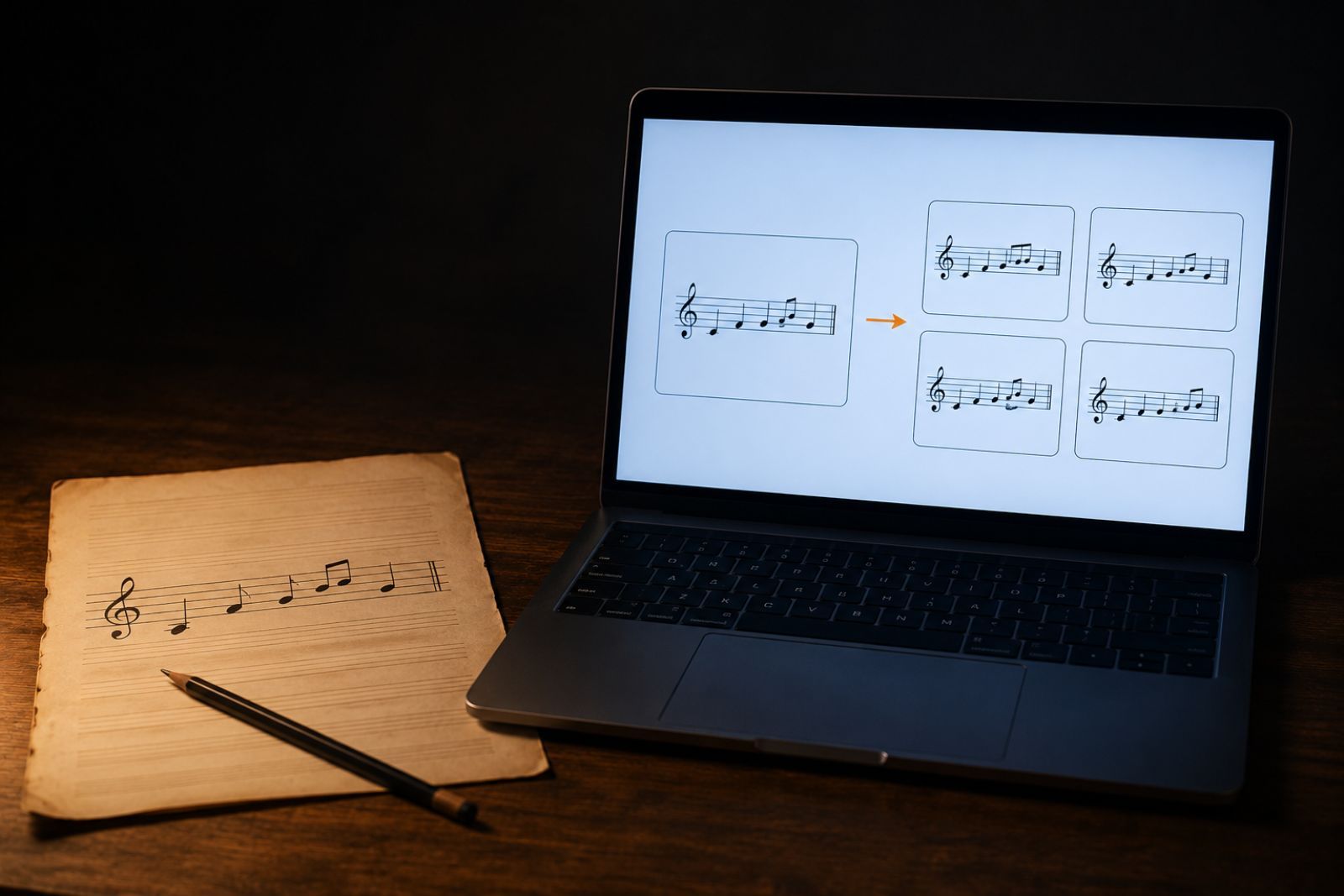
Where I notice the practical difference is in iteration. Starting an idea on a blank page is slow: every variant costs time, so you explore few before committing to one. With a generative tool as support, I can try ten variants of an idea in the time it used to take me to sketch a single one, and discard nine without it costing me anything to have tried. It’s not that the tool decides for me which variant is the good one — that remains human judgment — but it does let me reach that decision having seen more options, and in more depth on each, than if I had settled for the first sketch out of sheer time economy.
That is the difference between tool and final product. The final product — the piece, the composition, the decision — remains mine. The tool only helped me get there sooner and explore more.
Data sovereignty: the condition that makes this sustainable
Everything above — a tool that amplifies rather than replaces; fast iteration on your own judgment — only works if the person using AI knows what data goes into it and what happens to their own. The fear from SGAE I described above is not a fear of technology: it is a fear of losing control over one’s own data without having consented to it. That is exactly the same concern behind the Digital Bond Manifesto that governs this site and the rest of the Xiringase projects: counting is science, identifying without consent is something else.
In practice, this translates into three commitments I also apply to my own work with AI. First, knowing what data each tool uses: if a model is trained on my work, I want to know it and decide it, not discover it later in an output that resembles mine too closely. Second, the GDPR is not a bureaucratic obstacle, it is the minimum legal baseline that protects exactly that control within the European Union: what personal data is processed, for what purpose, and with what consent. Third, data sovereignty is also silicon sovereignty where possible: preferring local inference or self-hosted models over depending on a third party that trains on whatever you send it — exactly the sixth principle of that manifesto. I develop this idea in more detail, including the European legal framework (GDPR and the AI Act), in Data sovereignty: from principles to architecture.
This is not an anti-AI stance. It is the same idea in this piece applied to the origin of the data: a tool that truly helps is one you use with knowledge and consent, not one that uses you without your knowing it.
References
The references this article draws on, and where to read further:
- Rondini, S., Cerdá-Company, X., Rodríguez-Fornells, A., Álvarez, C., Penacchio, O., and Dediu, D. (2026). “Stable Diffusion Models Reveal a Persisting Human–AI Gap in Visual Creativity”. Advanced Science.
- University of Barcelona (2026). “La creatividad humana aún supera a la IA”.
- Williams, R. (2026). “La IA supera una prueba humana de creatividad, aunque esto no signifique ser creativa” (original in Spanish). MIT Technology Review en español.
- López, I. (2026). “Miguel Leiro: ‘La IA va a polarizar mucho en los sectores creativos, porque no va a haber espacio para la mediocridad’”. El País, ICON Design.
- SGAE / Know Media / Universidad Carlos III (2025). “El impacto económico y social de la inteligencia artificial en la creación musical”.
- SGAE (2026). “Mesa sobre IA en Bilbao: ¿te lo perdiste?”.
- Sánchez-Silva, C. (2026). “Los ingresos de la SGAE escalan a un nuevo récord de 393 millones”. El País, Economía.
- Colomer, B. (2026). “La SGAE cambia de objetivo: la IA generativa es el peor enemigo de la infracción de derechos y la piratería, no los usuarios”. El Chapuzas Informático.