
Essay · Essays
The brothers who said no to Philips: the 1942 Galician tape recorder
Two Galician brothers invented a machine that recorded sound on steel wire in a family workshop, in the middle of the post-war years and with barely any electronic components available. When Philips wanted to buy the technology from them, they said no. This is the real story, with its bittersweet ending.
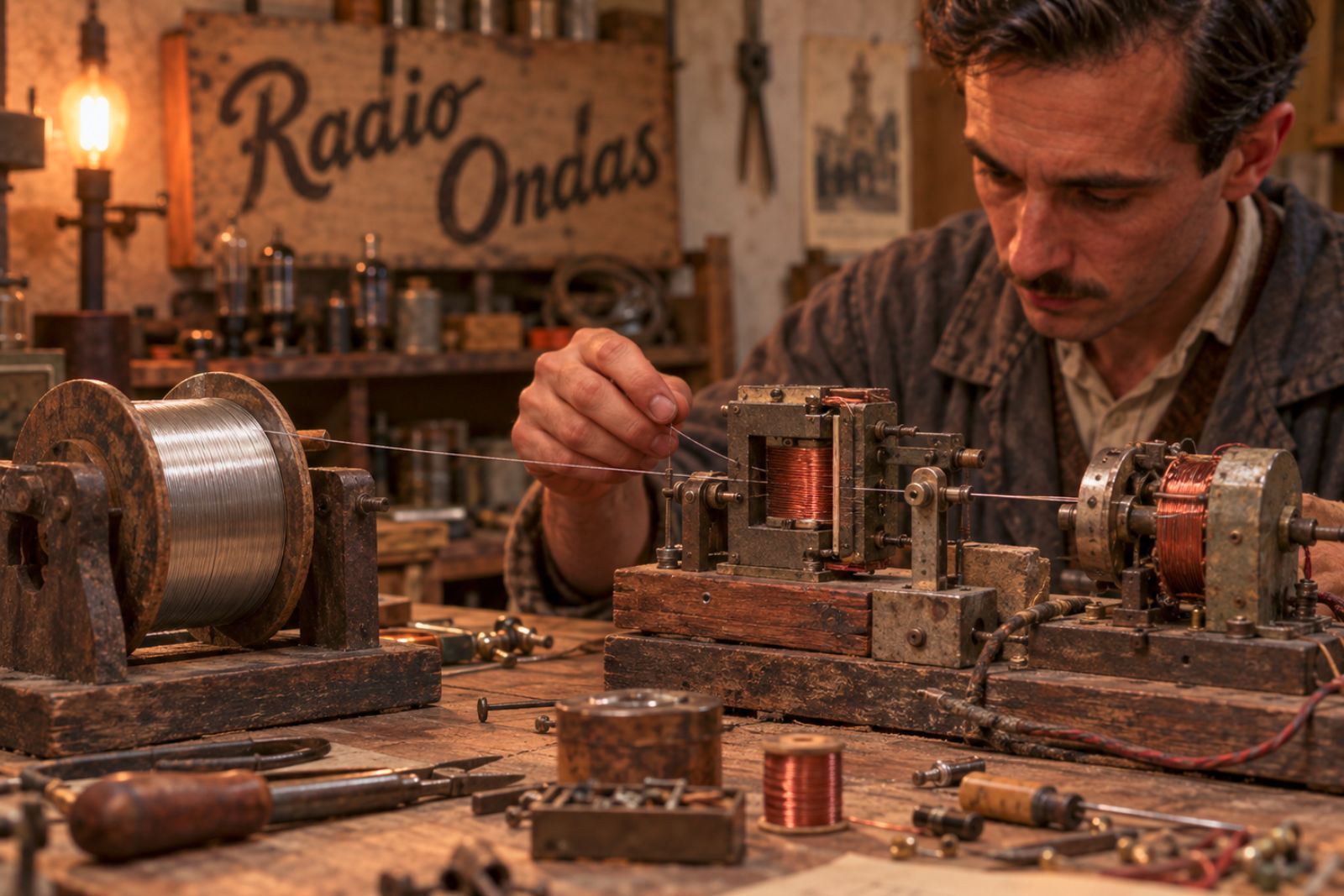
Picture this: in 1942, in a family workshop in Santiago de Compostela, with barely any electronic components available and Spain cut off from the rest of the world, two brothers build a machine that records the human voice on a steel wire thinner than a hair. Years later, Philips —the multinational that by then was already selling radios and household appliances across Europe— offers to buy the technology from them. And they say no.
The header image of this article is a digitally generated conceptual recreation, not a real historical photograph of the Portela Seijo workshop or their invention —no verifiable period photograph of the original device survives that we’ve been able to confirm—.
This story is real. It isn’t a Galician urban legend, nor an anecdote inflated over time: it’s documented through the family’s own testimony and reported in recent press coverage. And it isn’t just a nice historical curiosity —it’s a real case study in what it costs to bet on doing things your own way, with the real consequences that brings, good and bad at the same time.
Who José and Juan Portela Seijo were
José Portela Seijo was born in 1907; his brother Juan, in 1913. By the time they built the tape recorder in 1942, José was about 35 and Juan about 29. These weren’t amateurs who stumbled onto a discovery by chance: José had already taken part, in 1933 —nine years earlier— in setting up one of the first experimental radio stations in Santiago. He was, in today’s terms, a radio engineer with real experience before this project. Juan, for his part, was a conservatory-trained musician: he brought the ear, the judgment on whether what they were recording sounded right or not.
The two of them ran the family business “Radio Ondas”, a radio and electronics workshop on Rúa do Hórreo in Santiago de Compostela. There, among spare parts and tools, they built their tape recorder.
What exactly a steel-wire magnetic recorder is
Before going further, it’s worth pausing on the key term: magnetic recorder. Today we associate “recording sound” with a phone or a cassette tape, but the original idea is simpler and more physical than it seems: if you pass a magnetizable material —like a steel wire or tape— past an electric head while someone speaks or sings, that head can “record” the variations in sound as a pattern of magnetism along the wire. Afterwards, running that same wire past another head lets you read that pattern and turn it back into sound. There’s no ink, no physical groove carved like on a vinyl record: it’s pure magnetism, invisible to the naked eye.
The Portela brothers’ invention used a steel wire about 0.1 millimetres thick —nearly the width of a human hair—. The motors that moved that wire at a constant speed, they wound themselves, by hand, in their own workshop. There was no precision-components factory to call up: if you needed a specific motor, you built it yourself.
A real invention, but not the world’s first
Here it’s worth being precise, because it’s easy —and tempting— to tell this story as “the Galicians who invented magnetic recording.” That isn’t the case, and saying so without qualification would strip rigor from a story that doesn’t need it to be interesting.
Magnetic recording on steel wire has existed since 1898, when the Dane Valdemar Poulsen patented the Telegraphone and won the Grand Prize at the 1900 Paris World’s Fair with it —where, incidentally, he recorded the voice of Emperor Franz Joseph of Austria—. Between Poulsen and the Portela brothers there’s a real chain of technological development across Europe: in the 1920s, the German Kurt Stille improved the system with electronic amplification; in the 1930s, Ludwig Blattner and later Marconi moved from wire to steel tape, and the BBC itself used that technology to record a real speech by King George V in 1930. Almost in parallel, Fritz Pfleumer and the company AEG developed magnetic oxide tape in Germany —the direct ancestor of the cassette tape we’ve all used at some point—, with a working prototype already in 1935.
In other words: when José and Juan Portela built their tape recorder in 1942, the underlying physical principle had been invented 44 years earlier, and much of Europe had already moved on to tape. The brothers’ real merit isn’t having been first in the world —they weren’t—. It’s having replicated and improved that principle with extreme craft methods, in a country under autarky, without easy access to components or to the technical literature that engineers in Germany, Denmark or the United Kingdom had at hand. According to the sources that document the case, their erase-and-rerecord system ended up better than that of many contemporary tapes —a real technical improvement, achieved from isolation, not from advantage.
The Philips offer, and the “no”
In the late 1940s, representatives from Philips —by then already one of Europe’s major electronics multinationals— travelled to Santiago de Compostela. It wasn’t a courtesy call: they brought a real offer to buy the technology the brothers had developed.
José and Juan said no. They didn’t want to sell the patent and watch another company mass-produce, in another country, what they had built with their own hands. They wanted to manufacture it themselves, in Galicia.
This is the part of the story that sounds like a heroic gesture, and in a way it is: turning down real money from a multinational over a conviction about who should control that technology is not a small decision. But telling only this part would leave out the more comfortable half of the story.
The real ending, without sugarcoating
The mass-production project never got completed. In post-war Spain, securing raw materials and the state backing needed to set up industrial production was extremely difficult —the same autarky that had forced them to invent with whatever they had at hand later became the obstacle that kept their bet from fully paying off.
That doesn’t mean it stayed an isolated prototype nobody ever saw. They built, by hand, around twenty units, which they sold to institutions like Radio Nacional de España and to private individuals with the means to buy one. There was real production, though never at the industrial scale they had imagined when they said no to Philips.
The family kept working in sound technology after this: years later they registered a real patent, the “OrganSound”, in 1972. The family business, the shop “Radio Ondas”/Portela Seijo, stayed open in Santiago de Compostela for 85 years, until it closed in March 2024.
Why this story matters today
It isn’t an uncomplicated hero story, nor a story of failure. Both things were true at once: two brothers with real technical talent built, from isolation, their own version of a technology that already existed in the world; they had a genuine chance to sell that technology to a multinational; and they chose not to, betting on a kind of technological sovereignty that —at least at the industrial scale they dreamed of— never fully came together.
It’s a concrete case of something that keeps repeating throughout the history of technology: the decision to control yourself what you’ve built, instead of selling it to whoever has more resources to manufacture it, doesn’t always turn out well —and even so, it remains a decision someone can make with their eyes open, knowing the real cost it carries.
References
- Cadena SER. «Los hermanos gallegos que inventaron un magnetófono y rechazaron vendérselo a Philips». Hoy por Hoy A Coruña, 26 September 2026. Primary source, with testimony from the Portela family’s descendants.
- El Español (Quincemil). «Portela Seijo, los hermanos gallegos que plantaron a Philips y no vendieron su invento: el magnetófono». 18 January 2026. Independent second source, confirms the central facts and provides the wire-thickness figure (0.1 mm) and the OrganSound patent date (1972); not linked here as no independently verifiable URL was available at the time of writing.
- Computer History Museum. Storage Engine. Reference museum on the history of data and sound storage, consulted for international historical context on magnetic recording (Poulsen, Stille, Blattner, AEG/Pfleumer); the specific Telegraphone page is not linked as its exact URL could not be verified.