
Guide · Music Informatics
openDAW: an open-source DAW that lives in the browser
What openDAW is, how it works in the browser using the Web Audio API and TypeScript, why it does not compete with major DAWs but helps understand how they work, and how its data sovereignty model connects with GDPR principles and free software.
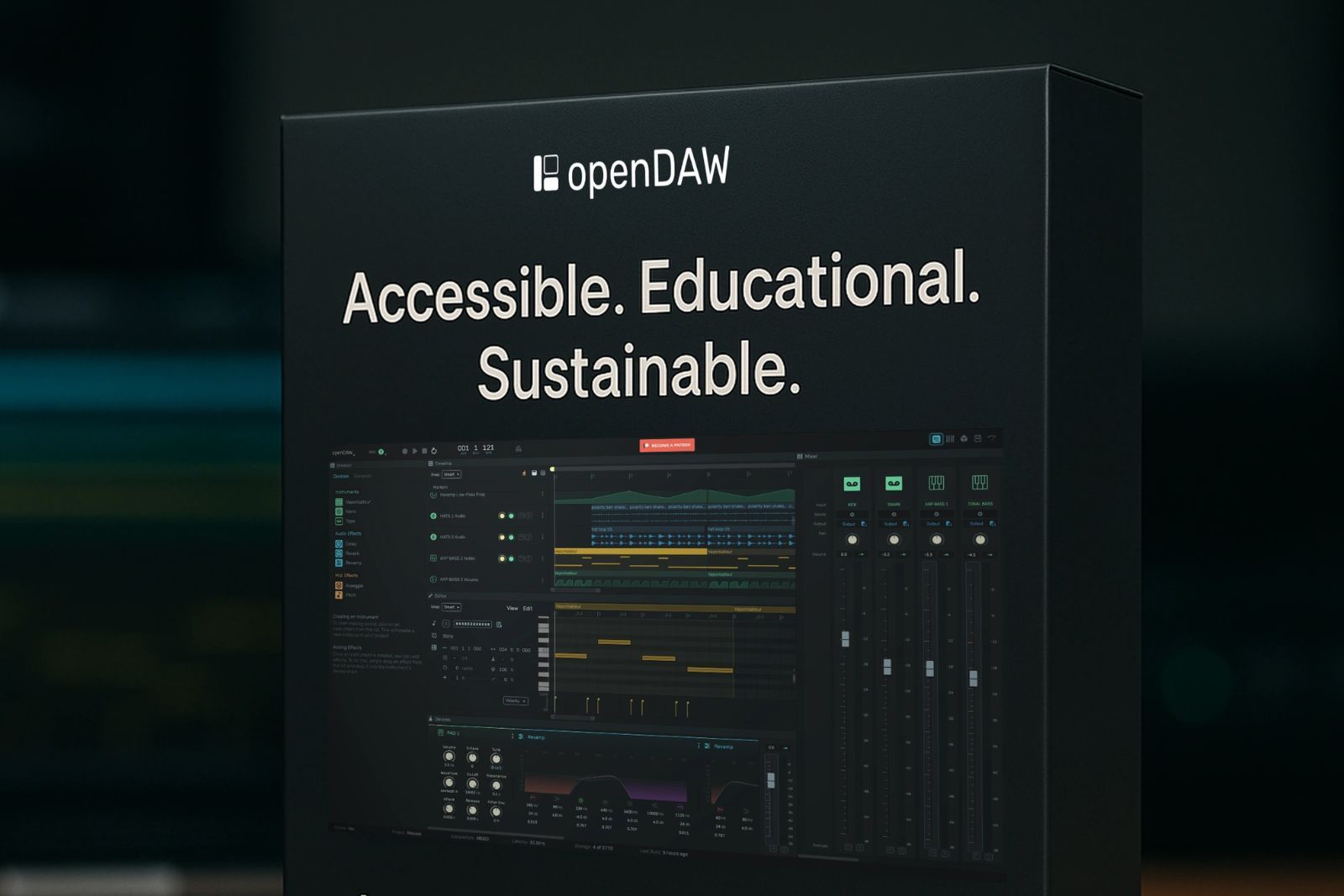
The first time I opened openDAW in the browser I expected a limited demo. It is not. It is a full DAW that runs without installing anything, without registering, without leaving a trace. For someone who works on automatic music transcription and needs accessible tools for teaching and research, that is not a minor detail.
It is developed by André Michelle and is available at opendaw.org. The source code is on GitHub under the AGPL v3 licence.
What a DAW is and why the browser
A DAW — Digital Audio Workstation — is the environment where audio tracks, virtual instruments, effects and the mix coexist. Historically these have been native applications: tied to the operating system, expensive and with steep learning curves.
The Web Audio API, available in any modern browser, changed the equation: it allows processing audio with low latency, managing effect nodes and synthesising signals directly from JavaScript. openDAW builds on that foundation to offer a production environment that requires no installation. Access is universal: any device with a browser can open it.
Not here to compete, here to explain
openDAW does not aim to replace Ableton or Pro Tools. That clarification matters, because it completely changes the way you evaluate it.
Major DAWs are professional environments with decades of development, proprietary plugin ecosystems, hardware integrations and massive production communities. Learning to use them well takes months. Understanding how they work internally — what an effect node does, how signal flows between tracks, what a bus is, how a synthesis chain is implemented — is a different matter entirely.
openDAW occupies that second space: it is a tool for learning, exploring and collaborating. The code is readable, the architecture is transparent, the plugins are written in TypeScript — a language any developer can read — and two of the instruments, Apparat and Spielwerk, are directly programmable from the browser. For anyone studying music informatics or wanting to understand how a synthesiser is built, that is worth more than a thousand user tutorials.
The community that forms around that goal is also different: it is not a community of producers comparing plugin chains, but one of developers building an open-source tool together. The project accepts contributions with a single condition: whoever submits code must understand every line they sign. AI-assisted code is accepted, but requires documenting the process. It is an honest stance on collective responsibility in shared code.
The project philosophy
The first thing you read in the README is a declaration of principles:
No SignUp. No Tracking. No Cookie Banners. No User Profiling. No Terms & Conditions. No Ads. No Paywalls. No Data Mining.
It is an explicit stance against the SaaS subscription and surveillance model that dominates creative tools on the web. The project minimises external dependencies — the core architecture is TypeScript without heavy frameworks — and delegates to the browser what the browser already does well.
Data sovereignty and self-hosting
There is something in openDAW’s architecture that goes beyond privacy as a feature: it is privacy as an inevitable consequence of design. By running entirely in the browser, the user’s projects never need to leave their device. There is no server to process them, no account to index them, no company to retain them.
This connects directly with the principles of the GDPR — the EU General Data Protection Regulation —: data minimisation, limited purpose, user control over their information. openDAW complies by design, not by company policy.
For those of us who work with digital sovereignty principles — the idea that technology should expand people’s autonomy, not create opaque dependencies — this architecture is more than efficient: it is coherent. Where there is no data, there is no tyranny. It is not a slogan; it is an engineering decision.
The project also allows fully self-hosted deployment: there is a Tauri wrapper in development that packages the application as a native desktop app, and the web version can be served from its own infrastructure. An educational institution, a research group or a technology cooperative can run their own instance without depending on any external provider.
What comes out of the box
openDAW ships with more than 26 stock plugins grouped into three categories:
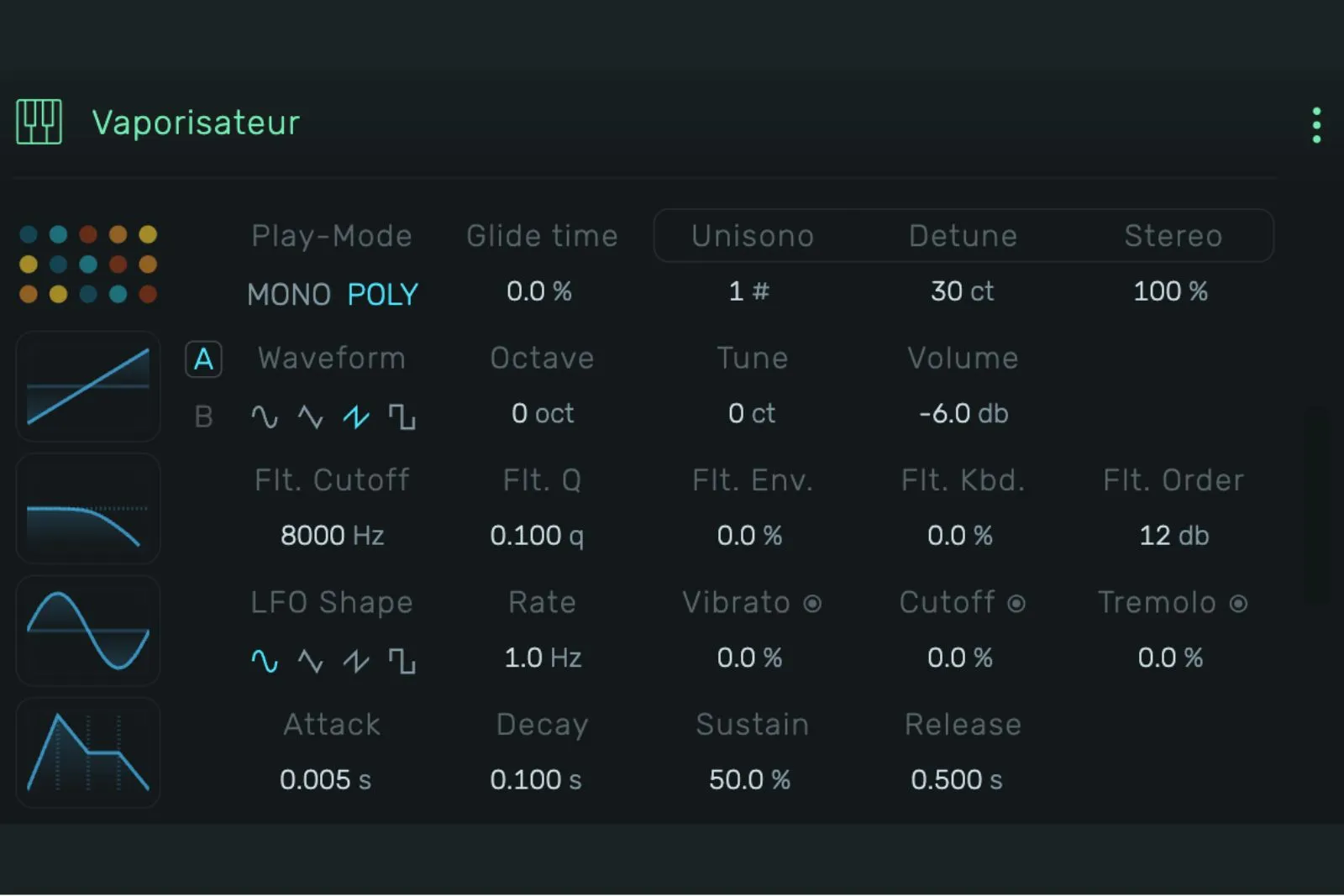
Instruments: the subtractive synthesiser Vaporisateur, a SoundFont player, a sampler (Nano Sampler) and two instruments programmable in JavaScript — Apparat and Spielwerk — that allow writing synthesis logic directly in the browser.
Effects: Dattorro and FreeVerb reverb, delay, vocoder, waveshaper, gate, maximizer, crusher and several dynamics processors.
MIDI tools: arpeggio, pitch shifter, velocity manipulator and external MIDI output, which allows connecting openDAW to external hardware or software via the standard protocol.
Technical architecture
The project is a monorepo managed with Lerna and Turbo. The stack is primarily TypeScript (95 % of the code), with Sass for styling. External dependencies are deliberately few: jszip for packaging projects, markdown-it for the integrated documentation, d3-force for visualising the plugin connection graph, soundfont2 for sampled instrument banks, Zod for schema validation and FFmpeg in WASM for audio encoding and decoding.
Why it is interesting for research
From my work in automatic music transcription, what interests me most about openDAW is that it lowers the barrier to entry without sacrificing depth. Four concrete lines:
| Scenario | openDAW advantage | Current limitation |
|---|---|---|
| Reproducible experimentation | No server: pin an exact version and share the URL | Audio engine in JavaScript; high latency under load |
| Programmable plugins | Apparat and Spielwerk allow defining synthesis in JavaScript, directly in the browser | No access to low-level audio APIs (WASM still in development) |
| Friction-free teaching | No installation or licence; works from any device on day one | Learning curve if you want to program your own plugins |
| Readable code | TypeScript without heavy abstractions; the signal chain is traceable in the code | Large monorepo; finding your way around takes time |
Project status
In June 2026, openDAW has 1,800 stars on GitHub and 43 open issues. The audio engine is still the most latency-sensitive part — the main limitation to bear in mind before adopting it in a demanding workflow — with a WASM engine in active development.
For musician-researchers working with Asturian bagpipe corpora, having an open, self-hostable web environment to explore synthesis and process signal without depending on proprietary licences is a piece that fits well in a sovereign toolchain.
A note on the dual licence
AGPL v3 means anyone can use, study and modify the code, but if they deploy it as a network service they must publish their modifications. The commercial licence exists for those who need to integrate it into closed-source products without that obligation. For academic, teaching and personal use, AGPL covers everything.
References
- Michelle, A. openDAW (GitHub repository). https://github.com/andremichelle/openDAW
- MDN Web Docs. Web Audio API. Mozilla Foundation.
- European Parliament and Council of the EU. General Data Protection Regulation (GDPR), Regulation (EU) 2016/679. EUR-Lex, 2016.
- Free Software Foundation. GNU Affero General Public License v3.
- Laplante, A. (2022). “Open source music software.” In The Oxford Handbook of Music and Corpus Studies (pp. 201–219). Oxford University Press.
Frequently asked questions
-
¿openDAW es gratis?
Sí, para uso académico, docente y personal. openDAW se distribuye bajo licencia AGPL v3: libre de usar, estudiar y modificar. Si alguien lo despliega como servicio en red, la AGPL obliga a publicar las modificaciones. Existe una licencia comercial separada para quienes lo integren en productos de código cerrado. Más detalle en openDAW: un DAW de código abierto que vive en el navegador.
-
¿openDAW necesita instalación?
No. openDAW corre íntegramente en el navegador: basta con abrir opendaw.org. No hay instalación, no hace falta crear una cuenta y los proyectos no salen del dispositivo. Lo cuento en detalle en openDAW: un DAW de código abierto que vive en el navegador.
-
¿Qué diferencia hay entre openDAW y Ableton o Logic?
openDAW no aspira a reemplazar a Ableton ni a Logic Pro. Su objetivo es distinto: aprender cómo funciona un DAW por dentro, experimentar con síntesis y producción sin barreras de acceso, y colaborar en una herramienta de código abierto. Los DAW profesionales tienen décadas de desarrollo, ecosistemas de plugins propietarios y comunidades de producción masivas. openDAW apuesta por el código legible en TypeScript y plugins programables desde el navegador. Lo explico en openDAW: un DAW de código abierto que vive en el navegador.
-
¿Qué es un DAW y qué ventaja tiene que funcione en el navegador?
Un DAW (Digital Audio Workstation) es la herramienta central de la producción musical digital: graba pistas de audio e instrumentos virtuales, aplica efectos, mezcla y exporta el resultado. Que openDAW viva en el navegador elimina la barrera de instalación —basta con abrir la URL— y democratiza el acceso a herramientas que antes requerían software de pago y hardware específico. Lo analizo en detalle en openDAW: un DAW de código abierto que vive en el navegador.