
Essay · Essays
Sound makes quantum jumps too: what Stanford saw for the first time
We knew that sound fades in jumps, but nobody had seen it happen live. A Stanford team did it by measuring without breaking what is measured.
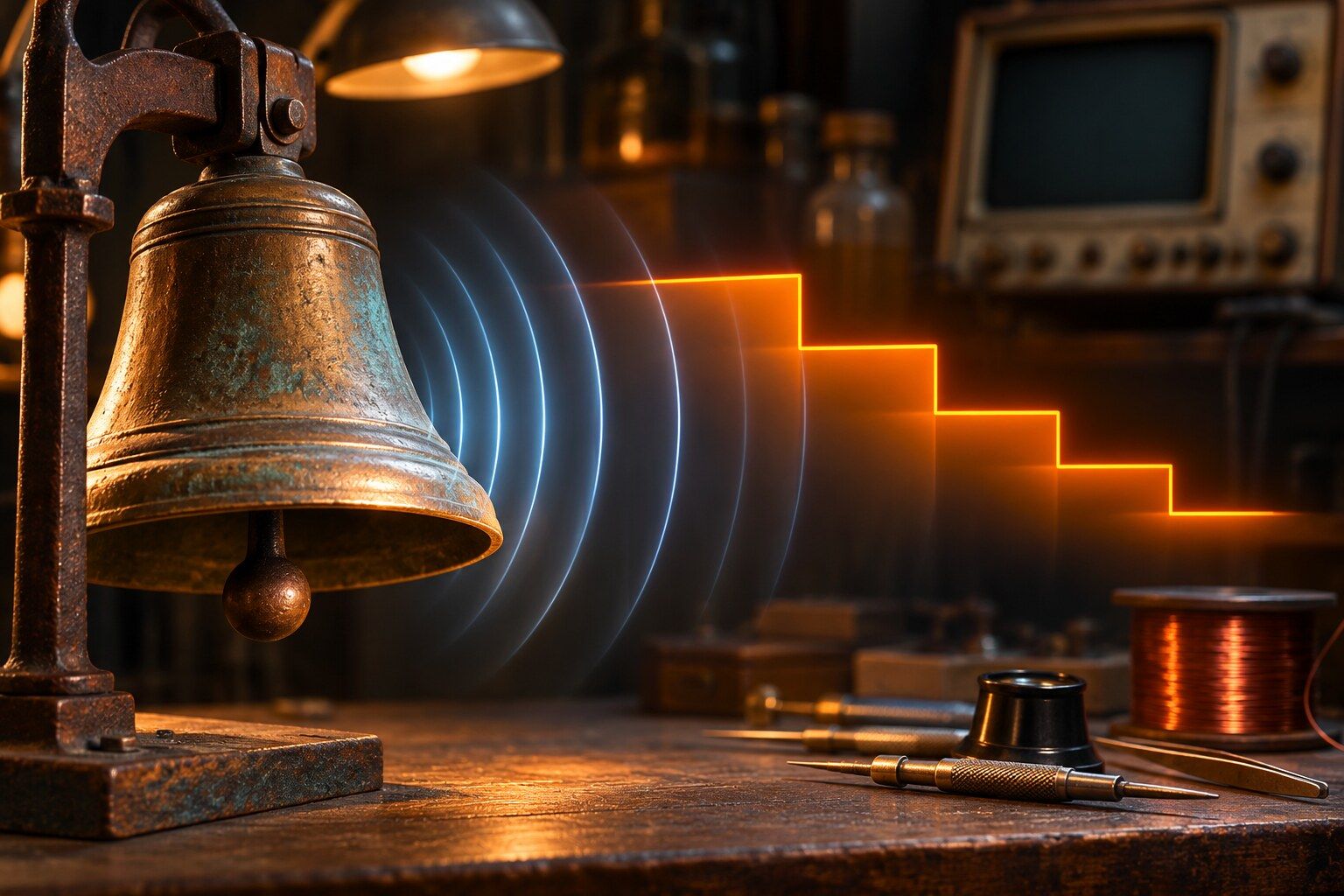
Think of a bell. You strike it, and the sound fades little by little: loud at first, softer and softer, until you can no longer hear it. To our ears, that decline is continuous, with no steps — a smooth curve falling to silence.
At the quantum level, it is not like that. The energy of that vibration does not drop continuously: it falls in jumps, in discrete steps, as if the bell went from one energy level to another without passing through the values in between. Each step is the loss of one phonon, the smallest unit of sound — I explain it below. This has been known for more than a century, from quantum theory itself. What nobody had managed until now is to watch it happen, live, as it happens. A team at Stanford University, led by physicist Amir Safavi-Naeini, has done it — and the result was published in 2026 in the journal Science.
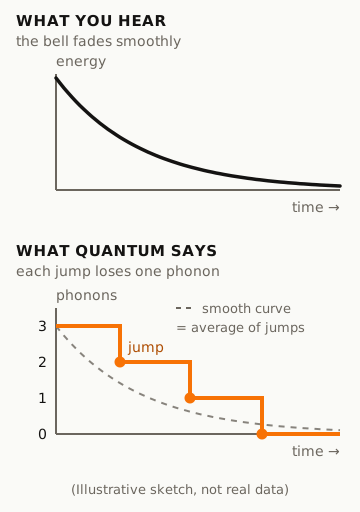
What you hear (top) and what happens inside (bottom): the smooth curve is the average of a great many steps.
Listen to a bell fading (synthetic sound, not from the experiment):
What a phonon is, without formulas
To understand the finding you need one word: phonon. It is the smallest unit of sound at the quantum level, the sonic equivalent of the photon — the smallest particle of light, which probably sounds more familiar —.
But there is an important difference between the two that should not be overlooked: a photon is, in a sense, an isolated entity travelling through space. A phonon is not. It represents the coordinated movement of an enormous group of atoms vibrating together, at the same time, in sync. It is not a loose “particle of sound” out there: it is the way quantum physics describes the collective vibration of a material, packaged into discrete units of energy.
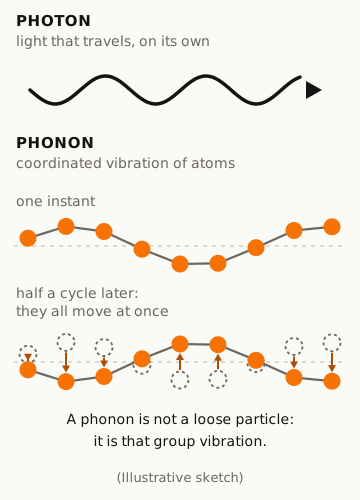
A photon travels on its own; a phonon is the coordinated vibration of many atoms at once.
When that vibration loses energy — like the sound of the bell fading — it does so by losing phonons one at a time, in jumps, not continuously.
Why this is so hard to observe
Here is the real problem, the one that prevented seeing these jumps in a vibrating object: in quantum physics, measuring a system normally alters it. If you try to observe what state a quantum particle is in, the very act of measuring tends to “collapse” that state — it changes it, destroys it or disturbs it irreversibly. It is as if, to know which step someone is on while walking down a staircase, you had to push them: you would learn where they were, but you would have altered where they go next.
The Stanford team solved this with a specific experimental setup: a microscopic mechanical resonator — a tiny structure that vibrates, the miniature equivalent of the bell from before, with an effective mass of about 0.2 picograms: two tenths of a trillionth of a gram — connected to a superconducting qubit: a tiny circuit, cooled to temperatures close to absolute zero, that behaves like a two-level quantum system (0 and 1). It is the building block of quantum computers; here it does not compute anything, it works as a sensor.
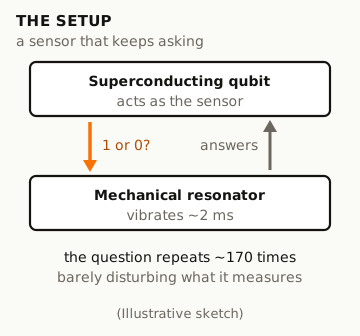
The setup: a sensor (the qubit) that asks again and again.
The resonator keeps vibrating for about two milliseconds. In that window, the qubit asks about 170 times whether there is one phonon or none (really, whether the number of phonons is even or odd). Each question disturbs what it measures a little, but very little: according to the paper, it preserves the phonon number 99 % of the time. This is what is called, in the jargon, a “non-destructive” measurement: it measures without breaking what is measured. Since each reading on its own is doubtful, many in a row are needed to be sure. What comes out of this is what matters: not only confirming that the system changed state, but pinpointing the exact instant of each jump.
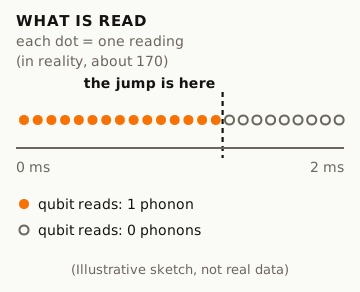
What a jump looks like: with so many readings in a row, you can see when the phonon disappears.
They also achieved something that comes before all this: starting from a single phonon with guarantees. In their jargon it is called “heralding”: since each reading is doubtful, only when several in a row point to “there is one phonon” is the state considered prepared, and then there is an 85 % probability that there is exactly one.
Technical detail, for those who want the numbers
- Measurement: parity checks of the phonon number with a superconducting qubit dispersively coupled to the resonator (328 kHz per phonon).
- Duration of each check (qubit readout and reset): about 12 µs.
- Mechanical lifetime: 2.1 ms intrinsically; it dropped to 649 µs under continuous monitoring because of the back-action of the measurements themselves (destruction probability of 0.013 per check).
- Accuracy of a single reading: parity assignment fidelity of 0.68; qubit readout of 0.91.
- Heralding: after six consecutive results indicating “one phonon”, P(n = 1) = 0.85.
Source: Makihara et al., Science 2026 (preprint version, arXiv).
A phonon lasts a very short time
Measurement was only half the problem. At first, the phonons in the device lasted about 800 nanoseconds (according to Physics World), far below the millisecond needed to watch them decay. The lifetime — how long the resonator keeps vibrating before it dies out — had to be extended, and they did it: it reached 2.1 milliseconds, more than two thousand times longer.
To achieve this, the qubit and the resonator were integrated into a single device with a technique called transfer printing: placing one microscopic piece precisely on top of another without damaging either.
Observing something this subtle does not depend only on a good theoretical idea: it depends on knowing how to build the right instrument.
Quantum jumps had been seen before
Here we need to be precise, because it is easy to oversimplify: this is not the first proof that quantum jumps exist, nor the first proof that sound is quantum in theory. Both things were already known.
Quantum jumps were proposed by Niels Bohr in 1913, and first observed in 1986, in a different system: individual trapped ions. And it was not the discovery of a single scientist, though it is sometimes simplified that way: it was three independent research groups, almost at the same time, each with its own experiment (Nagourney and Dehmelt on one side, Bergquist and his team on another, Sauter and his on a third). In 2007, Gleyzes, Haroche and their team saw jumps in the number of photons in an electromagnetic cavity (a sort of box that traps light), probed with atoms.
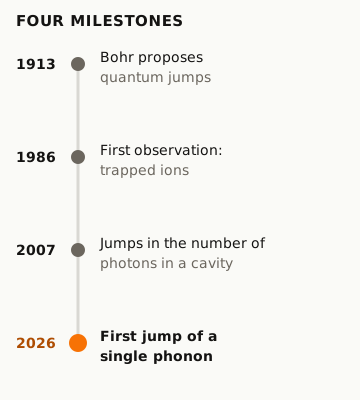
Four milestones: from Bohr’s proposal to the first jump of a phonon.
What is genuinely new in the 2026 Stanford experiment is not “sound is quantum” — that was already known. It is the direct, real-time observation of a quantum jump happening in a single phonon, something that had remained elusive for decades precisely because of the difficulty of measuring without destroying. Put another way: they did not discover that the bell “jumps” at the quantum level — we already knew that from theory.
They managed, for the first time, to watch it jump as it jumps.
What it could be used for
This experiment is not just a curiosity of fundamental physics with no application. Safavi-Naeini’s own team is already working with the group of Michael Roukes at Caltech to explore whether this same measurement system — able to detect mechanical vibrations at the quantum level — could be used to detect and identify proteins inside cells, according to Phys.org. It is a concrete biomedical application, not the generic reference to “quantum computing” that usually accompanies this kind of news.
It makes sense if you think about it this way: if you have learned to measure extremely subtle vibrations while barely disturbing them, that same tool could be used to detect equally subtle movements in other systems — such as the mechanical vibrations of a molecule inside a cell.
How far it goes today. It is a proof of concept, not a finished tool: Safavi-Naeini himself acknowledges that, for uses such as quantum error correction or measuring the mass of individual proteins, the vibrations would still have to last about ten times longer than they do now (Physics World).
What I take from this finding
What makes this experiment interesting is not a spectacular claim about the nature of sound — we have had that for a century. It is the demonstration that, with enough measurement precision, you can directly observe something that until now we could only infer indirectly. A real bell holds an immense number of phonons, and the jumps, one at a time, get lost in the smooth curve that our ears hear. What is new is that, for the first time, someone has managed to isolate a single one, look closely and watch it jump.
Keep reading: The Fourier transform: from time to frequency, to see how a sound breaks down into frequencies, and How to compute a spectrogram with librosa, to see it in a real audio file.
References
- Makihara, T. et al. «Quantum jumps of sound». Science, 2026, 393 (6817): 1217–1220. Full text consulted in its arXiv preprint.
- Bohr, N. «On the constitution of atoms and molecules». Philosophical Magazine, 1913, 26: 1.
- First observations of quantum jumps (ions, 1986), in Physical Review Letters: Nagourney, Sandberg and Dehmelt, 56: 2797 (DOI); Sauter, Neuhauser, Blatt and Toschek, 57: 1696 (DOI); Bergquist, Hulet, Itano and Wineland, 57: 1699 (DOI).
- Gleyzes, S. et al. «Quantum jumps of light recording the birth and death of a photon in a cavity». Nature, 2007, 446 (7133): 297–300.
- Physics World. «Sound waves come in quantum jumps». 2026. Source of the phonon lifetime at the start and of the current limits.
- Phys.org. «Real-time quantum jump in sound observed for first time». 2026. Source of the collaboration with Caltech.